Friday, November 15, 2013

Breadfruit insect repellent


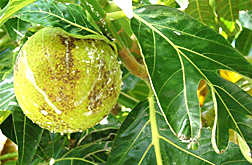
Photo: Breadfruit.
 
US Department of Agriculture scientists have confirmed that breadfruit, used as a folk remedy in Pacific regions to control insects, is an effective mosquito repellent.
 
Click here to read more.

Friday, March 22, 2013

Increasing heat tolerance in plants

A USDA scientist and his colleagues have opened the door to development of more heat-tolerant crops by crystallizing a plant protein (found in the creosote bush) that plays a key role in photosynthesis.

Click here for more.

Saturday, July 14, 2012

Cut throat competition and modern marketing yield a pretty penny profit from Cuties.

The Big War Over Cuties - WSJ


Sunday, February 12, 2012


This Wall Street Journal article sounds like a consulting opportunity for some enterprising CRFG member(s):


 Gardens of Eden Sprout in Synagogue and Church Yards, but They Aren't Very Fruitful

http://online.wsj.com/article/SB10001424052970203646004577213033000884426.html?mod=WSJ_hp_editorsPicks_4


Thursday, December 29, 2011

Guerrilla Grafters - potential liability for CRFG????

Perhaps this explains the very large quantity of scions I saw a few young folks taking from the exchange last year. How do we ensure that CRFG does not become in some way liable if these fruit anarchists use our resources to graft edible "nuisance" varieties onto ornamental street trees??? How do we harness their youthful enthusiasm to do good fruit grafting works within the law?

http://www.fastcoexist.com/1679037/guerrilla-grafters-splicing-fruit-bearing-branches-onto-city-trees


Wednesday, December 21, 2011

Frankincense threatened by conditions in Ethiopia

The world may still have gold and myrrh, but it's quite possible that frankincense could become a thing of the past, given ecological pressures on the arid lands where it grows in Ethiopia.

http://www.usatoday.com/tech/science/environment/story/2011-12-20/frankincense-endangered-ethiopia/52130102/1

Tuesday, November 22, 2011

How to Trademark a Fruit

Interesting article in The Smithsonian about early and artistic attempts to protect fruit varieties.

http://www.smithsonianmag.com/arts-culture/How-to-Trademark-a-fruit.html#

Tuesday, August 23, 2011

S.F. Plays Host to Millions of Bees

Thanks to my backyard neighbor, and his hard working yet docile honeybees, I never worry about fruit set.

http://www.sfweekly.com/2011-08-17/dining/urban-beekeeping-san-francisco-caroline-chen/

Wednesday, June 1, 2011

Dragon Fruit Does It All Night Long

Nice time lapse video of a flowering Dragon Fruit on YouTube.

http://www.youtube.com/watch?v=ODzg2dBJSoA

Anyone care to hazard a cultivar guess?

Looks like Cebra to me.

Friday, May 6, 2011

Heritage Fruit & Nut Trees in the Sierra Foothills

Thanks to Idell for spotting this great article, Treasure of the Sierra Foothills: Heritage Fruit and Nut Trees Discovered and Preserved , which describes how "Organic farming pioneer, Amigo Cantisano, is carrying on the work of Felix Gillet, the father of perennial agriculture in the West. The discovery of 100-year-old orchards has saved a wealth of fruit and nut genetics."

It wasn't that long ago, yet who remembers Felix Gillet?

"His main introductions are walnuts, almonds, chestnuts, filberts, prune plums, the European culinary plum, cherries, pears, apples, figs, strawberries, raspberries, Bing cherry, French prunes and others.

"In one of his catalogs, he had 241 varieties of grapes. He brought in wine grapes, table grapes, and raisin grapes, all of which formed the industries. Felix brought in almost all the common varieties that we grow and use today. When you drink Merlot or Cabernet Sauvignon or Petite Syrah or Chardonnay or Sauvignon Blanc, those are French varieties, or when you eat what’s now called a Thompson seedless grape or raisin, that is a French variety that came originally from Afghanistan."

Amigo Cantisano and his associates have "been documenting these plants all over the Sierra foothills and Sacramento Valley. There are literally hundreds of sites, farms, homesteads, ranches, and town sites that still have these plants growing really thrift-fully. They are true Permaculture plants. In most cases, they get no care by human beings and they are really hardy. Weather permitting, they produce amazing crops.

"We have been cataloguing these and identifying them as best we can by variety, and when possible, tracing back the history of them, because sometimes they’re on a homestead that’s got its entire history still intact. One of the places we work on is a state park that is an old mining town, and it has all its history, so we’re able to document the era of these plants. There are literally thousands of them."

It's a great, amazing story - check it out!
Thursday, February 17, 2011

California Cherimoya Association Annual Meeting

Saturday, March 5, 2011

Mira Costa College
1 Barnard Ave., Oceanside, CA
Rooms 3449, 34450 (Aztlen) student center

Bring cherimoya seed and budwood to share.

10:00 am. Registration
10:15 Introduction
10:30 Mira Costa Horticulture programs--Jason Kubrock
10:50 Status of Cherimoya collection in Irvine--Dr. Gary Bender
11:10 Break
11:20 Alta Vista Garden: Additional Cherimoya planting--Art and Dottie Logan
11:40 Varietal discussion Panel---Q. and A.
12:15 pm Lunch provided
1:00 Business meeting
1:30 Tour of Mira Costa Orchard

Driving directions to Mira Costa College from Hwy 78, take College Ave North past Vista Way to the next signal (Barnard) Turn Left .4 miles to Mira Costa Lot 3B.

Reservations $25.00, Students $15.00.

Make checks payable to California Cherimoya Association; must be received by March 1, 2011.

Send to: CCA, c/o J. Bathgate, PO Box 2262, Valley Center, CA 92082

Questions?? Contact Jim Bathgate, (760) 749-3359 or email JLBathgate@sbcglobal.net.

Friday, January 7, 2011

Wednesday, January 5, 2011

How to Cut Scions

Here is a video from Richmond Grows on how to cut scions for the Scion Exchange.


And click here for more information on what to bring, how to prepare, the labels mentioned in the video, directions, lists of plants that are patented (which means don't bring them) and now off-patent, and lots of other useful information.

Friday, December 3, 2010

Reuters article on Citrus Greening Disease Huanglongbing (HLB)

Article suggests that the only solution may be to develop genetically modified varieties that are resistant to the bacteria.

http://www.reuters.com/article/idUSTRE6B24ZE20101203?pageNumber=1

Tuesday, September 21, 2010

The Campaign to Save Russia's Pavlovsk Seed Bank.

An incredible reservoir of genetic diversity - almost 1000 kinds of strawberries, for example - is threatened by real estate developers who need land for vacation homes.

Read about it here.